
Employment
Workplace Training That Sticks: Smarter Induction & Professional Development

Workplace training has traditionally been designed around moments in time – induction, annual refresher training, and the occasional professional development day.
A staff member joins, completes their induction training, works through a set of compliance modules, and receives a certificate. Boxes are ticked. Records are filed. The organisation can demonstrate that training occurred.
But when a complex or high risk situation arises months later, a familiar problem emerges – much of that training has been forgotten.
This isn’t a reflection of staff motivation or professionalism. It’s a predictable outcome of the way most workplace learning is structured.
At Good Practice Hub, we’ve taken a deliberately different approach – one grounded in contemporary learning science and designed specifically for human services. The result is a practice-based model of professional development that prioritises retention, confidence, and capability, not just completion.
The hidden weakness of induction heavy workplace training
Research consistently shows that adults forget new information rapidly when it is not revisited or applied. The phenomenon, often described as the forgetting curve, has been validated across more than a century of research and remains a central challenge in modern workplace training. In practical terms:
- Large volumes of induction content overwhelm working memory
- Learning delivered once is not designed for long term recall
- Annual refresher training is often too infrequent to meaningfully strengthen memory.
In human services, this matters. Induction training frequently covers high stakes knowledge – safeguarding, privacy, health and safety, professional boundaries, legislative responsibilities. When recall fades, risk increases.
Adding more content or longer training sessions does not solve this problem. Learning science is clear: durable learning requires active use and repeated retrieval, not repeated exposure.
Retrieval practice: the most reliable way adults retain learning
One of the strongest and most recent bodies of evidence in learning science supports retrieval practice – the act of actively recalling information from memory as a foundation of effective professional development.
Large scale reviews and meta analyses published in the past five years show that learners who regularly retrieve information:
- Retain significantly more after weeks or months
- Transfer knowledge more effectively to real world situations
- Develop a clearer understanding of what they do and don’t know
A 2021 systematic review covering nearly 2,000 studies found retrieval practice produced medium to large learning gains across disciplines and learning contexts, including applied and professional education (Agarwal et al., 2021).
More recent studies in health and professional education confirm that retrieval- based learning improves long term retention and real world application compared to review based training models.
This is why the Good Practice Hub centres learning around short, targeted practice quizzes. Each quiz is designed to prompt recall – not recognition – and provide immediate feedback that strengthens understanding.
Why micro learning fits the reality of human services work
Professional development often doesn’t happen in ideal conditions. Human service teams work across shifts, homes, community settings, and high pressure environments.
This is where micro learning becomes not just convenient, but pedagogically sound.
Recent research into workplace micro learning shows that short, focused learning activities:
- Improve engagement and completion rates
- Reduce cognitive overload
- Support knowledge retention when combined with retrieval practice
A 2024–2026 body of research into corporate and healthcare training demonstrates that micro learning paired with active recall leads to improved performance and stronger knowledge retention than traditional long form training (Choudhary P & Potdar, P 2024).
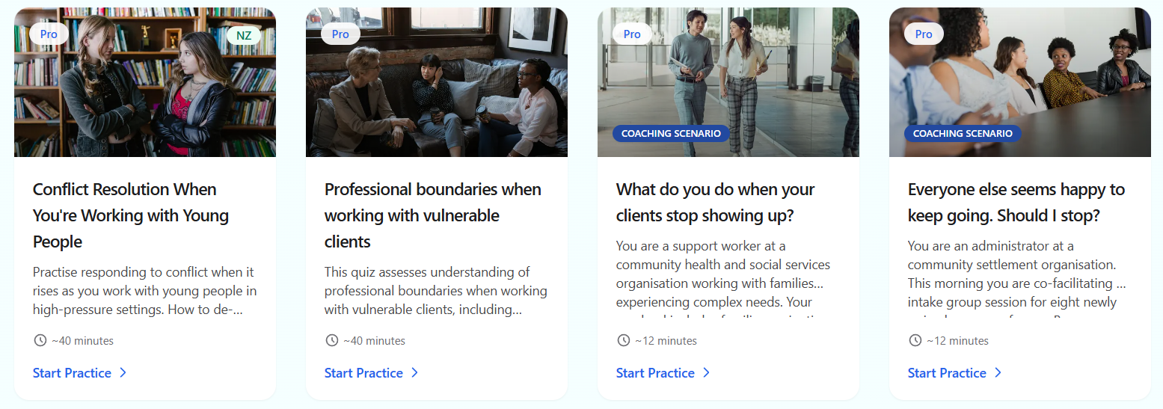
Good Practice Hub quizzes take less than 30 minutes to complete. They can be used:
- During induction
- In supervision conversations
- As part of ongoing professional development
- As regular knowledge “check ins” rather than one off events
The power lies not in their length, but in frequency and accessibility.
Spaced repetition: turning induction into continuous learning
Another principle embedded into Good Practice Hub is spaced repetition – the practice of revisiting learning over time rather than delivering it in a single block.
Recent meta analyses demonstrate that spaced retrieval practice produces substantially higher long-term retention than massed learning, with particularly strong effects in professional and health education contexts.
In workplace training terms, this means:
- Induction is no longer a one time event
- Knowledge is strengthened through revisiting, not re teaching
- Learning becomes part of everyday professional practice
The Good Practice Hub makes this easy by keeping quizzes always available, allowing staff to return to topics without starting again or repeating entire courses.
From compliance training to professional confidence
Traditional compliance training often positions learning as something to endure. Staff complete it to satisfy regulatory requirements, not because it directly improves their confidence at work.
Practice based learning changes this dynamic. When quizzes are framed as practice rather than assessment, engagement improves. There is no pass or fail. Staff can repeat quizzes, reflect on gaps, and build confidence incrementally.
Research in continuing professional development shows that this approach supports deeper self regulation and stronger learning outcomes in adult learners.
Over time, organisations benefit from a workforce that is not just technically trained but genuinely prepared.
Better evidence for employers and regulators
Professional development evidence typically focuses on attendance -who completed what, and when.
Practice based learning provides richer data. The Good Practice Hub shows:
- Which topics staff have actively practised
- How knowledge changes over time
- Where additional support may be needed
This aligns with contemporary expectations around workforce capability and continuous improvement in human services and healthcare settings.
Designed specifically for human services induction and professional development
The Good Practice Hub is purpose built for:

- Disability services
- Community and social services
- Mental health services
- Addiction services
- Child & Youth services
- Family Harm/Sexual Violence services
- Aged care and family services
Content is aligned to Australian and New Zealand legislation and tailored by jurisdiction and role, ensuring induction and ongoing workplace training are relevant, current, and credible.
As regulations and practice standards evolve, content is updated supporting professional development as a living process, not a static requirement.
A more effective way to invest in workplace learning
The evidence is clear. If the goal of workplace training, induction, and professional development is safe, confident, and capable practice, then training has to be more than one – off delivery.
Practice based, retrieval-focused, spaced learning is not a trend. It is the best supported approach in modern learning science.
The Good Practice Hub makes this practical for human services organisations. Accessible, evidence-based, and designed for the realities of frontline work.
Your team already has the potential. The Good Practice Hub helps them retain it, strengthen it, and use it when it matters most.
Frequently Asked Questions about Workplace Training and Induction
What is effective workplace training for human services?
Effective workplace training helps staff retain, recall, and apply knowledge in real situations. Research shows training is most effective when it includes retrieval practice, spaced repetition, and ongoing use rather than one‑off induction sessions.
Why is traditional induction training often ineffective?
Traditional induction focuses on content delivery and completion. Learning science shows that without regular reinforcement, most information is forgotten quickly. This creates risk in high‑responsibility roles such as disability, community, and health services.
How is practice‑based learning different from compliance training?
Practice‑based learning focuses on active recall and repetition, helping staff strengthen memory and confidence over time. Compliance training often demonstrates attendance; practice‑based learning demonstrates capability.
What is micro‑learning in professional development?
Micro‑learning delivers learning in short, focused activities that fit into daily work. When combined with retrieval practice, micro‑learning improves engagement, reduces overload, and supports long‑term retention.
How does the Good Practice Hub support induction and ongoing learning?
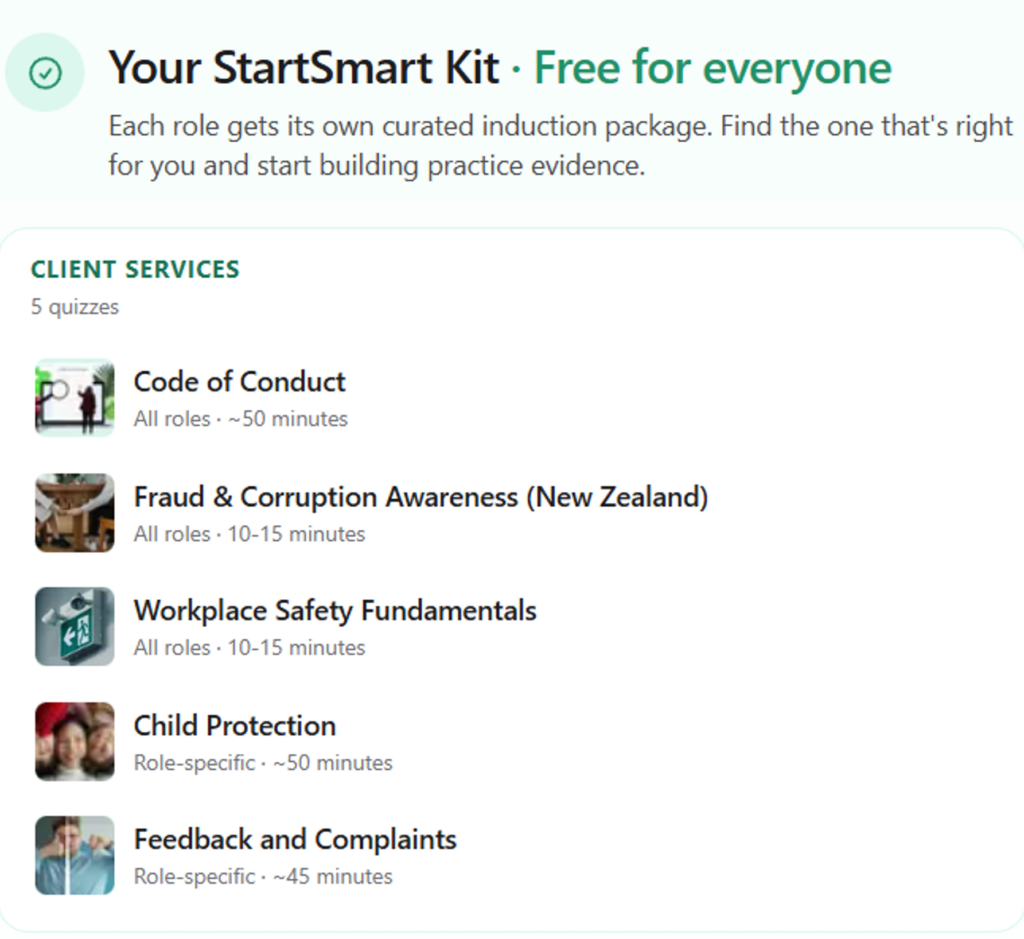 The Good Practice Hub provides role‑specific practice quizzes aligned to Australian and New Zealand legislation. Staff can revisit topics over time, supporting continuous professional development rather than one‑off training events.
Is this approach suitable for regulated environments?
Yes. Practice‑based learning strengthens knowledge retention, highlights gaps, and provides evidence of engagement- supporting governance, audit readiness, and workforce assurance.
References
Replication and Analysis of Ebbinghaus’ Forgetting Curve
What is the Forgetting Curve and How You Can Fight It
Agarwal P, Nunes L & Blunt J Retrieval Practice Consistently Benefits Student Learning: a Systematic Review of Applied Research in Schools and Classrooms, December 2021, Educational Psychology Review 33(1):1-45
Choudhary, P & Potdar, P (2024) The Impact of Microlearning on Employee Training and Development in Corporate Settings